
A ceramic package shell, also known as a ceramic encapsulation housing, is a type of packaging enclosure fabricated from ceramic raw materials. The ceramic shell provides hermetic sealing protection for the chip, endowing it with excellent reliability, high wiring density, and extreme stability in terms of electrical, thermal, and mechanical properties.

In optical modules, the ceramic package shell serves as a hermetic housing for encapsulating optoelectronic components, providing mechanical support, heat dissipation, hermetic sealing, and electrical connection functions for core devices such as lasers and detectors.
Ceramic Package Shell Manufacturing Process:
The process flow involves slurry dispersion → tape casting → punching → pattern printing → lamination → singulation (dicing) → sintering → nickel plating → brazing → gold plating → optical window welding → flying probe testing.
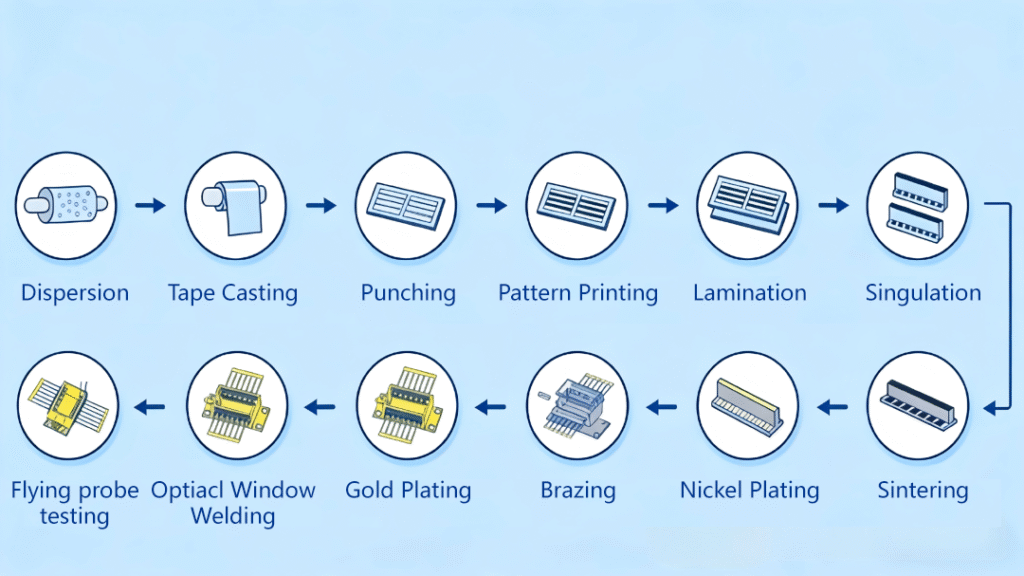
Types of Ceramic Package Shells:
Dual In-line Package (CDIP), Ceramic Pin Grid Array (CPGA), Ceramic Small Outline Package (CSOP), Ceramic Leadless Chip Carrier (CLCC), Ceramic Ball Grid Array (CBGA), Ceramic Quad Flat Package (CQFP), Ceramic Quad Flat No-lead Package (CQFN), and Ceramic Flat Package (CFP).
Application in Optical Modules:
Hermetic packaging methods primarily include To-can, BOX (Box-type), and Butterfly packages. These are mainly applied in the telecommunications market or DCI (Data Centre Interconnect) market, where operating environments are complex and reliability requirements are high.
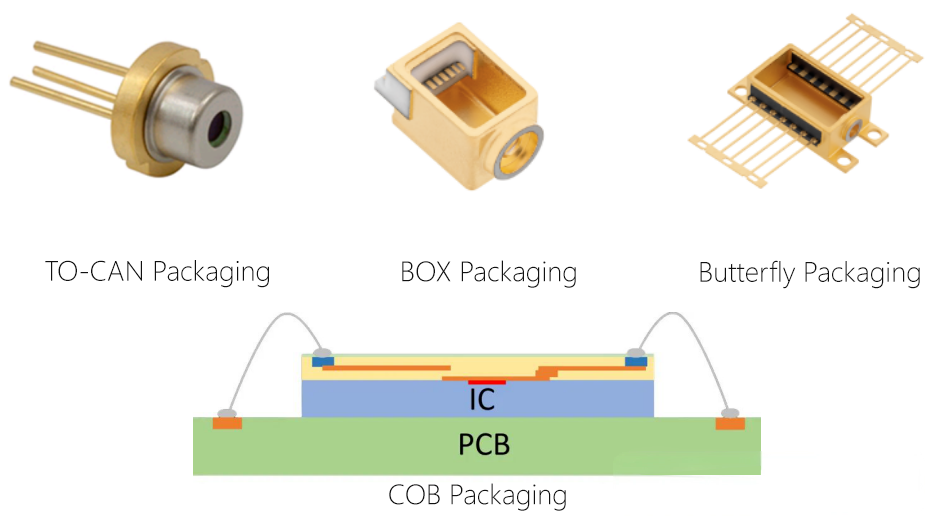
Non-hermetic packaging mainly utilises COB (Chip-on-Board) technology and is frequently used in data centre optical modules.
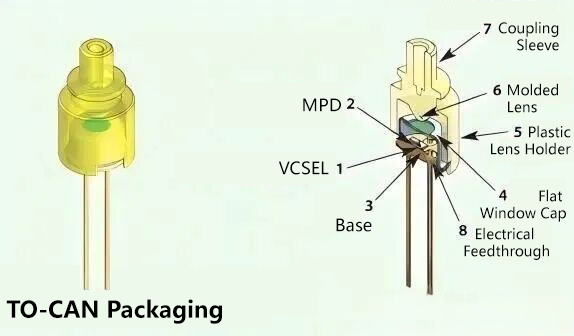
The To-can coaxial package is low-cost and simple to manufacture; however, its small size leads to poor heat dissipation, making it unsuitable for long-distance transmission. It is primarily used in markets with lower demands on transmission distance and rate, such as base stations and PON (Passive Optical Network) for single-channel applications (e.g., 2.5 Gbit/s and 10 Gbit/s short-distance transmission). Resistance welding equipment can be used for To-can hermetic sealing.
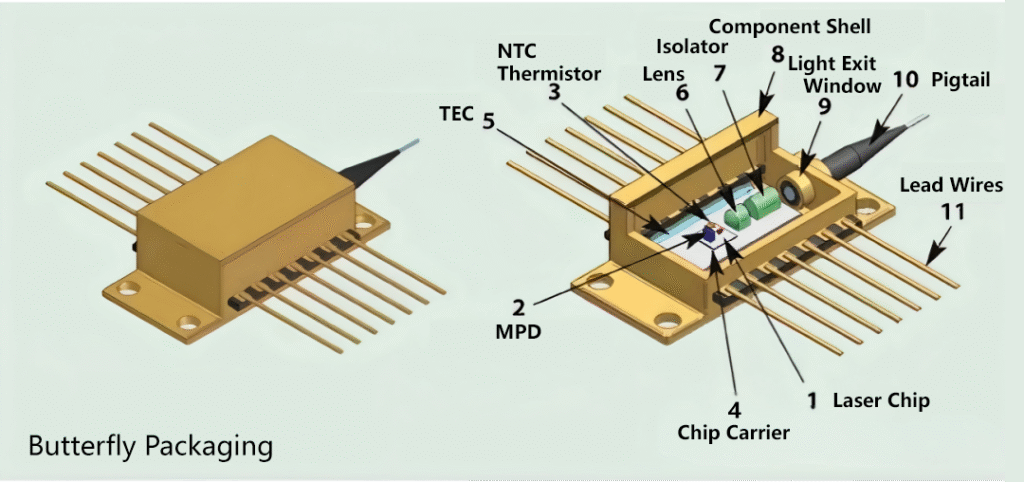
BOX/Butterfly packages are typically rectangular, featuring complex structures. They offer advantages such as multifunctionality and good heat dissipation, making them suitable for long-distance transmission at various rates. They are mainly used in transmission networks, predominantly in multi-channel configurations with high data rates and long distances (including 40G/100G/200G/400G and corresponding coherent optical modules), where reliability is paramount. The BOX package is an upgraded, multi-channel version of the Butterfly package and is suitable for high-speed optical modules at rates of 40G and above. With the advent of the 400G and 800G era, higher demands will be placed on parallel optical design. Parallel seam welding equipment is used to achieve BOX hermetic sealing.
The advantage of TO-CAN packaging lies in its high degree of standardisation and the easy availability of peripheral components. However, its structure is difficult to modify significantly, and design freedom is restricted. In contrast, ceramic packaging offers high structural freedom and can be customised according to specific specifications.
Appendix: For the product catalogue regarding ceramic package shells, please refer to this link:
https://xinluoceramic.com/product-category/electronical-application
