
Have you ever been curious about the following phenomena in life?
- Why are high-end smartwatches nowadays resistant to scratches when dropped and have a jade-like feel?
- What material is used for the ceramic crowns in dental implants?
- How can the delicate connectors in fibre-optic broadband withstand millions of plug-in and plug-out cycles without failing?
- Which type of ceramic is durable, wear-resistant, and rust-proof for automotive sensors and miniature precision gears?
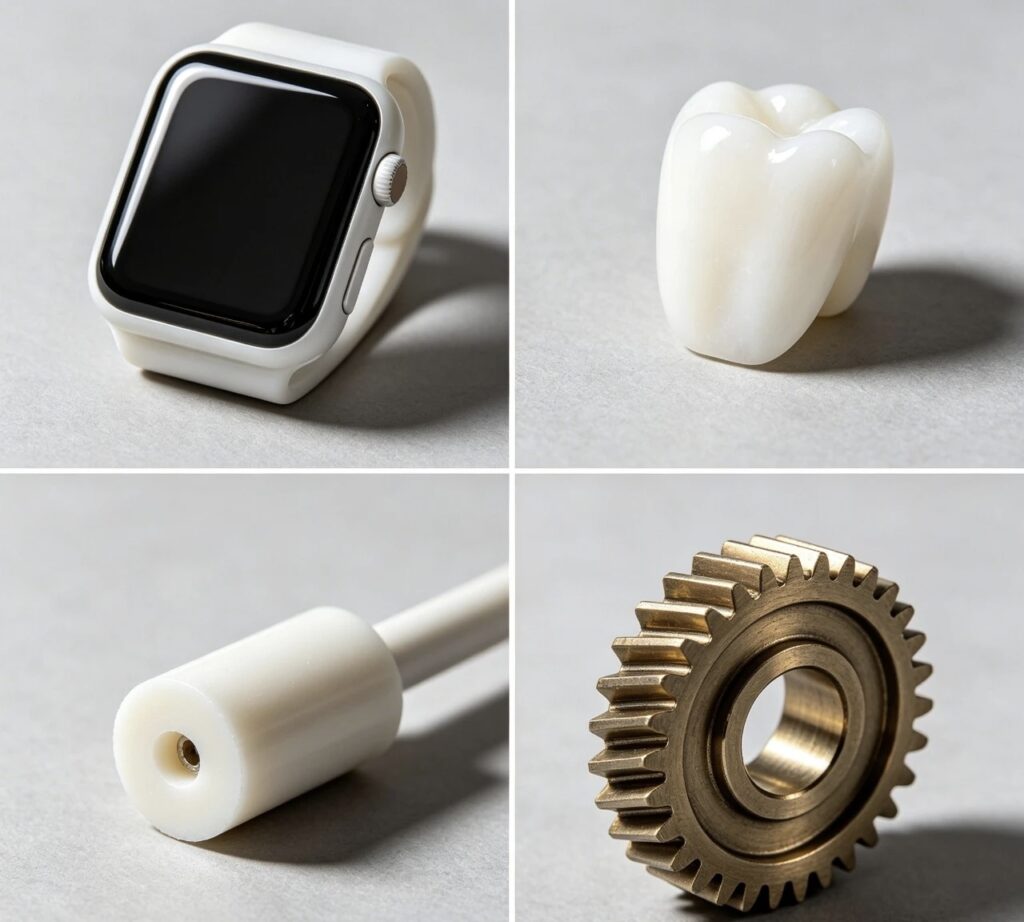
These four seemingly unrelated items are actually made from the same raw material. It is—zirconia (ZrO₂).
Are you momentarily stunned? You’ve probably never heard of this name before, yet it has quietly permeated our lives. Today, we’ll explain plainly: What exactly is zirconia? Why is it so ubiquitous?
Zirconia (ZrO₂), also known as zirconium dioxide, has a melting point of 2715°C. Powders appearing white usually indicate high purity; commonly used powders on the market often appear light yellow (containing iron) or light gray/dull white (containing natural hafnium impurities). Leveraging its five core advantages—high toughness, impact resistance, high strength, wear resistance, and transformation toughening—it has forcefully carved a niche in the traditional market dominated by alumina (Al₂O₃), achieving high-end substitution. A notable characteristic of zirconia is its possession of three crystalline polymorphs:
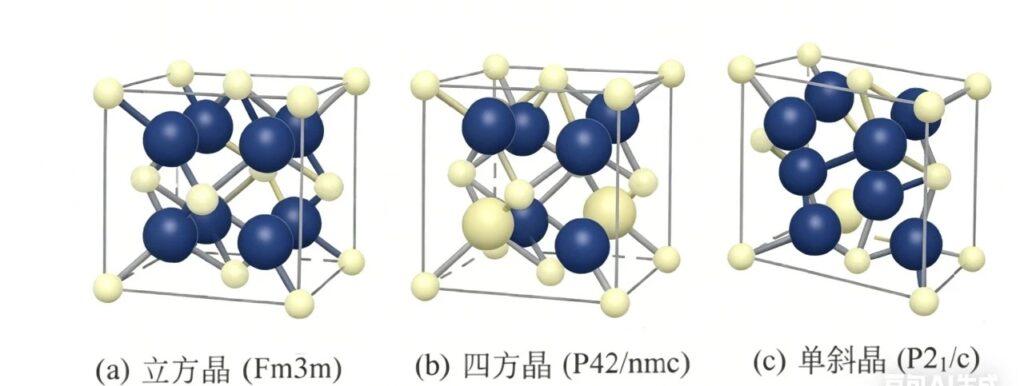
Figure 1-1: Zirconia Crystal Structure Diagram
- Monoclinic Zirconia (m-ZrO₂): Stable at low temperatures (<950°C), density 5.65 g/cm³; most commercially available zirconia powders are primarily in the monoclinic phase.
- Tetragonal Zirconia (t-ZrO₂): Stable in the intermediate temperature range (1200~2370°C), density 6.10 g/cm³. It can exist at room temperature when stabilised by additives like yttria (Y₂O₃).
- Cubic Zirconia (c-ZrO₂): Stable at high temperatures (>2370°C), with a density of 6.27 g/cm³, and exhibits ionic conductivity.
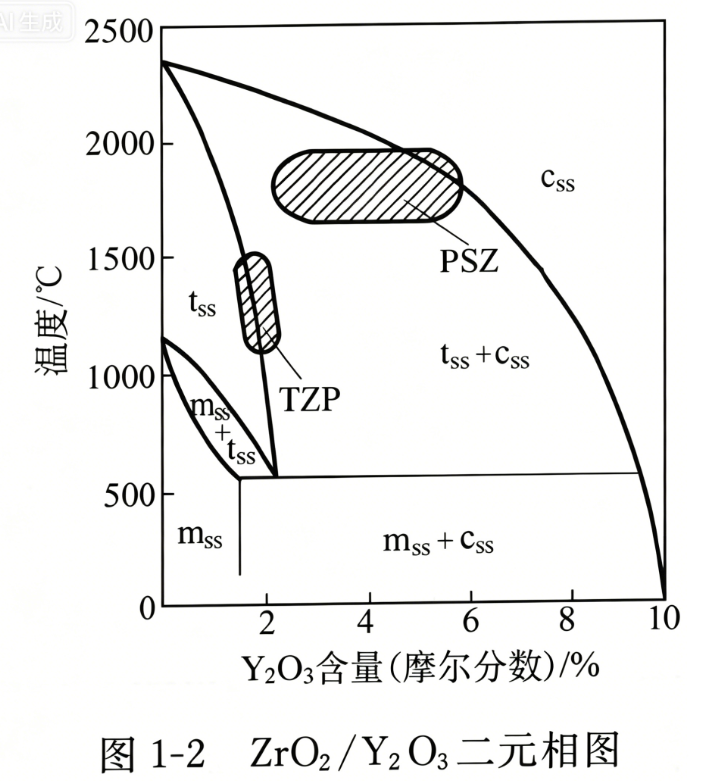
Toughened zirconia ceramics primarily feature three typical microstructures: 1) A dual-phase structure with t-ZrO₂ dispersed within a c-ZrO₂ matrix, known as PSZ (Partially Stabilised Zirconia); 2) A structure composed entirely of fine t-ZrO₂ grains, known as TZP (Tetragonal Zirconia Polycrystals); 3) t-ZrO₂ particles dispersed as a toughening phase in other ceramic matrices, such as ZTA (Zirconia Toughened Alumina). Among these, TZP exhibits the highest room-temperature mechanical properties within ZTC (Zirconia Toughened Ceramics) materials. Its doping types include Y-TZP, Ce-TZP, Mg-PSZ, Ca-TZP, etc., with Y-TZP being the most widely applied (its phase diagram is shown in Figure 1-2).
The mechanical properties of Y-TZP are closely related to the content of the stabiliser Y₂O₃, the grain size of t-ZrO₂, and the microstructure. Both factors influence the transformability of ZrO₂ and the transformation toughening effect, leading to performance variations among different TZP materials. The flexural strength of Y-TZP typically ranges from 800 to 1400 MPa, Vickers hardness from 1200-1300 HV (slightly lower than alumina’s ~1500 HV), Young’s modulus from 140-200 GPa, coefficient of thermal expansion (CTE) ~10.5×10⁻⁶ /K, and thermal conductivity 2-3 W/(m·K).
Thermodynamic and Kinetic Mechanisms of Zirconia Phase Transformation:
As a typical polymorphic oxide, zirconia undergoes reversible phase transformations (monoclinic ↔ tetragonal ↔ cubic) during continuous temperature changes. This transformation process exhibits typical martensitic transformation characteristics: diffusionless lattice reconstruction, fast transformation kinetics, accompanied by significant volume changes and shear strains. This is the core physical basis for zirconia’s transformation toughening effect.
From a thermodynamic perspective, pure ZrO₂ has defined critical temperature ranges for phase transformation: monoclinic m-ZrO₂ is the thermodynamically stable phase from room temperature to 950°C; tetragonal t-ZrO₂ dominates as the stable phase between 950~2370°C; complete transformation to cubic c-ZrO₂ occurs above 2370°C until melting at 2715°C.
Pure zirconia, without stabiliser doping, cannot retain its high-temperature cubic or tetragonal phases in a metastable state at room temperature. During natural cooling, it follows a stepwise transformation sequence: c-ZrO₂ → t-ZrO₂ → m-ZrO₂, ultimately reverting completely to the monoclinic structure.
Upon heating, the monoclinic-to-tetragonal transformation involves significant contraction, while the reverse transformation (upon cooling) involves significant expansion. The transformation process is accompanied by 3%~5% volume expansion and approximately 1% shear strain (some literature cites 7%-9%). The forward monoclinic-to-tetragonal transformation typically begins around 1170°C, while the reverse transformation initiates between 800~1000°C. This behaviour relates to the free energy, strain energy within the lattice, and additives that can form solid solutions with ZrO₂. The substantial volume change can induce microcracking, macrocracking, and structural disintegration within the material. This is the fundamental reason why pure zirconia ceramics cannot be directly sintered into structural components without stabilisation treatments.
Natural zirconia minerals and industrially produced zirconia powders commonly contain inherent impurity elements, with hafnium (Hf), iron (Fe), silicon (Si), and aluminium (Al) being the most typical. Zr and Hf belong to the same group in the periodic table, sharing similar ionic radii and chemical properties. Hf is difficult to completely remove from natural zircon sand via conventional purification processes. Residual Hf impurities have a minimal effect on powder colour (both high-purity ZrO₂ and HfO₂ are white) but can slightly elevate the phase transformation critical temperature and weaken the transformation-induced volume effect. Iron impurities typically dissolve in the zirconia lattice as oxides, imparting a light yellow or yellowish-brown hue to the powder. Excessive iron impurities can disrupt lattice integrity, reduce sintered density, and compromise mechanical stability, making them strictly controlled indicators in high-end electronic and medical-grade zirconia powders. Furthermore, powder purity is highly correlated with its intrinsic crystalline phase morphology.
For micron-sized, high chemical purity zirconia powder without stabiliser additives, the appearance is white, and the initial crystalline phase is monoclinic. It is important to note, however, that the yttria-stabilised tetragonal zirconia powder commonly used in industrial processes like Ceramic Injection Moulding (CIM), dry pressing, and hot pressing sintering typically has an initial crystalline phase that is not monoclinic. Additionally, ultrafine (nanoscale) pure zirconia powder may stabilise in the tetragonal phase at room temperature due to surface energy effects.
For more information, please get in touch with us via the details below:
https://xinluoceramic.com/product-tag/zirconia-ceramic
James Lin (Marketing Director)
Email: james@xinluoceramic.com
Tel/WhatsApp: +86-191-2995-4231
